Natural Marble Countertops in the San Fernando Valley — What Sets This Work Apart
When a marble countertop project is handled under a licensed general contracting contract, the scope looks very different from a typical stone shop transaction — templating, plumbing coordination, permit management, and final sealing all fall under one license rather than getting split across separate vendors. Los Angeles Kitchen and Bathroom Remodeling in Encino handles marble as a seamless extension of its flagship kitchen and bath remodeling service, not as an isolated stone transaction.
Based at 4419 Van Nuys Blvd, Suite 407, Sherman Oaks, the team has been serving the Valley since 2019. Unlike a countertop shop that templates, disappears, and sends someone else to finish, this team holds every phase of the project under one contract — and that distinction shows in the finished result.
Engineered surfaces can get close, but natural marble's translucent veining and depth are properties of the stone itself — nothing manufactured replicates them. Quartz mimics the look; marble delivers the material. Homeowners in Hidden Hills and across the San Fernando Valley can call +1 (310) 890-4885 or request a free online estimate to start a marble project anywhere across the Valley.
Finished Marble Kitchens and Bathrooms — What Clients Actually Get
A completed marble kitchen from this team is built around continuity — veining that reads as unbroken across a multi-slab island, waterfall returns mitered at precise profiles, and a penetrating sealer chosen to match what the specific stone actually needs. Seam positions are planned during templating — not improvised on installation day — so the finished surface reads as a cohesive piece of stone rather than a collection of cut pieces.
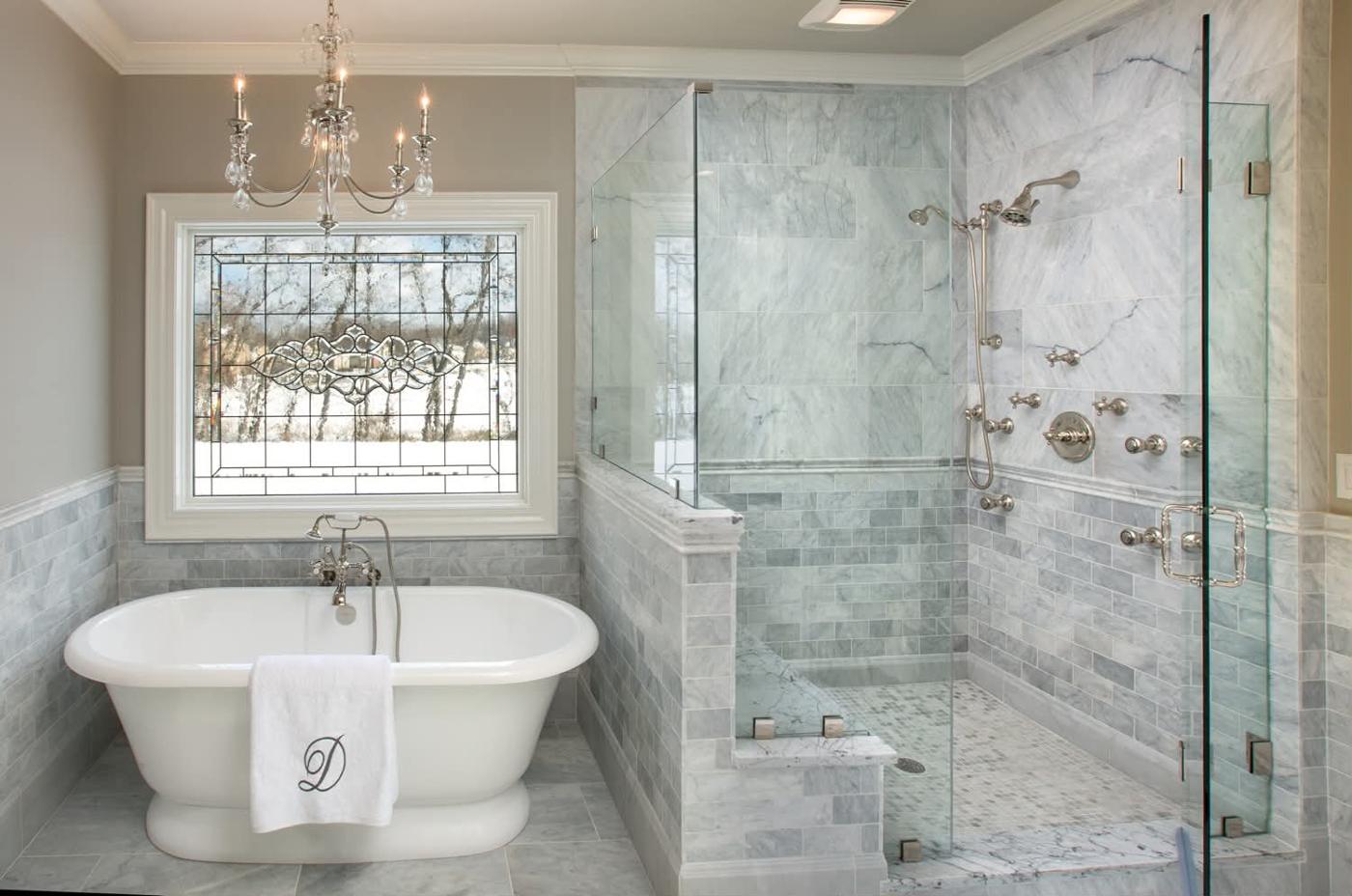
In bathrooms, marble shower surrounds, floating vanity tops with undermount sink cutouts, and grout joint dimensions are all determined during the design and templating phase. Measurements are taken on-site before a single slab is cut — that's what gives the finished result an architecturally considered quality rather than the slightly-off look that comes from cutting to drawings instead of actual conditions.
Clients in Studio City and Encino work with one point of contact from demolition through final walkthrough. Plumbing tie-ins, under-cabinet lighting circuits, and permit management are all handled in-house under the same licensed contractor — no subcontractor gaps, no permit surprises. The scope extends beyond countertops to kitchen islands, bathroom vanities, shower walls, and fireplace surrounds, giving remodeling clients in Sherman Oaks, Encino, and across the Valley a single team capable of executing marble at every surface in the home. Reach out at +1 (310) 890-4885 to discuss your project.
Marble Varieties We Fabricate: Carrara, Calacatta, and Statuario
Choosing the right marble variety means understanding both how each stone reads at full scale and how its character shapes fabrication decisions. Carrara features a soft grey-white background with fine, feathery grey veining. Its relatively consistent patterning makes seam-matching on bathroom vanity tops and shower floors in Sherman Oaks and Studio City homes more straightforward, where continuity across multiple slabs is critical to the finished look.
Calacatta presents a bright white background with bold, dramatic veining in gold and deep grey tones — and because no two slabs vein identically, in-person slab selection is non-negotiable for statement kitchen islands and waterfall countertops in Calabasas and Hidden Hills. Selecting Calacatta remotely from a website photo is how kitchens end up with mismatched character.
Statuario features an ultra-white base with thick, high-contrast grey veining that makes it well suited for fireplace surrounds and feature vanity walls where the stone is meant to anchor the room visually. Statuario typically comes in smaller slab quantities, so layout planning and material yield calculations happen before any cuts are made.
All three varieties are natural stone with measurable porosity. A professional fabrication process includes evaluating the absorption characteristics of each slab before specifying a sealer — applying a generic product regardless of what the stone actually needs is a shortcut that affects long-term performance.
Custom Fabrication Details: Mitered Edges, Waterfall Returns, and Matched Veining
A mitered edge is a defining detail in high-end marble fabrication. The slab face is cut at a precise 45-degree angle and joined at the edge, creating a visual thickness that reads as a solid block of stone — without laminating a second piece underneath. Because the cut follows the stone face continuously, the veining wraps the corner without interruption. On a Calacatta island, that unbroken vein movement around the front edge is what makes the piece look architecturally composed rather than assembled.
Waterfall returns carry that same principle vertically. The countertop slab turns down the island end panel, and the vein transition point is planned during digital templating before any cuts are made. The stone appears to flow from horizontal to vertical as a single continuous movement — an effect that depends entirely on seam alignment being treated as a fabrication calculation rather than a field decision.
On countertop runs requiring multiple slabs, orienting adjacent slabs at the yard before cutting allows the vein pattern to read as unbroken across the seam after installation. Edge profile selection — eased, beveled, ogee, or laminated — affects both visual weight and the exposed stone face's porosity, which changes how the sealer is applied and how often reapplication is needed. Heavier profiles like ogee expose more raw stone surface and require more thorough sealing attention than a simple eased edge.
Marble Kitchen Countertops and Islands in Los Angeles
Marble kitchen work is among the most common requests the team receives across Encino, Calabasas, and Hidden Hills — and each application type has distinct fabrication requirements. Perimeter countertops need seam placement that avoids high-traffic zones near the sink and cooktop. Peninsula extensions require slab continuity across the transition from wall cabinet to floating edge. Prep islands demand precise cutout engineering if an undermount prep sink is in the plan. Waterfall islands need the largest individual slabs and the tightest vein-matching discipline of any kitchen application.
Marble installation is sequenced within the broader kitchen remodel: cabinets are leveled and shimmed before the fabrication team templates, plumbing rough-in is complete before sink cutouts are marked, and backsplash tile layout is finalized around the marble's vein direction rather than retrofitted after the stone is down. Because permits for structural changes, gas line relocations, and electrical upgrades are pulled under the same general contracting license, there is no coordination gap between trades.
Homeowners starting a kitchen remodeling project can request a free online estimate by sending kitchen dimensions and slab preferences to the team — and the written quote breaks out fabrication, installation, and any associated plumbing or electrical scope separately, with no bundled mystery pricing. Call +1 (310) 890-4885 to get started.
Marble Bathroom Vanity Tops Across Sherman Oaks and Studio City
Marble vanity tops demand more precise cutout geometry than kitchen countertops — and the fabrication requirements shift significantly depending on the application. Single-sink tops with integral backsplash lips, double-sink tops spanning floating vanity cabinets, vessel sink platforms requiring flush-surface cutouts, and freestanding tub decks each carry different edge finishing profiles and plumbing clearance requirements. Getting that geometry wrong means a costly remake, which is why the team templates digitally after the vanity cabinet is set and plumbing rough-in is confirmed — not before.
This sequencing eliminates the field-measurement errors that occur when stone is cut to drawings rather than to the actual installed conditions. The template captures the true cabinet footprint, plumbing stub locations, and wall returns simultaneously, so the fabricated slab arrives ready to drop in without field trimming.
In Sherman Oaks and Studio City bathroom remodels, Carrara vanity tops are frequently paired with warm-toned wood-look tile floors and matte black fixtures. The team advises on slab selection during the material planning phase so the marble's grey undertones complement — rather than fight — the floor tone and hardware finish across the full palette.
The vanity cabinet, marble top, undermount sink, and all plumbing connections are managed under one licensed contract through the team's bathroom remodeling service — no separate stone shop to coordinate, no plumber sourced independently.
Marble Shower Walls and Surrounds — Design and Waterproofing
The waterproofing membrane — not the grout — is what keeps water out of the wall cavity in a marble shower. Before any stone is set, the team installs a membrane-based waterproofing system directly over the substrate, creating a continuous barrier that performs regardless of how tightly the marble joints are finished. Grout is a decorative joint, not a water seal, and treating it otherwise is one of the most common failure points in high-end shower installations.
Design options for marble surrounds range from large-format slabs with nearly invisible seams to running-bond or stacked-bond tile layouts, book-matched feature wall panels, and integrated niches with precision mitered corners that read as built-in architectural elements. Floor-to-ceiling slabs create the most seamless visual result but require the largest individual pieces — a material yield and handling calculation that happens during templating.
Marble shower floors require more frequent sealing than wall surfaces because standing water and concentrated soap residue accelerate absorption at the stone's face. The team applies a penetrating sealer at installation and provides every client with care and maintenance guidance specific to the marble variety installed — Carrara, Calacatta, and Statuario each present different sealing considerations.
These shower builds connect directly to the walk-in shower and tub-to-shower conversion services the team offers across Sherman Oaks and the Valley — complete with frameless glass enclosures, rainfall showerheads, and curbless entries where the layout allows.
Marble Fireplace Surrounds in Calabasas and Hidden Hills
A marble fireplace surround is fabricated as four distinct components — the hearth slab, two surround legs, and the mantel shelf — with an optional overmantel panel above. Each piece is templated individually and dry-fit before any adhesive is applied, so joints between components are consistent and the veining transitions cleanly across every connection point. Statuario and Calacatta suit installations where bold, high-contrast veining is meant to anchor the living room at scale. Carrara suits more restrained transitional interiors common in Sherman Oaks, where a quieter stone serves the overall palette better.
Structural execution depends on what sits behind the facing. Surround legs carry the full weight of the mantel shelf, and the anchoring method differs meaningfully between masonry fireplaces, zero-clearance factory units, and decorative gas inserts. The team's licensed general contracting background ensures substrate prep and fastening are handled to current Los Angeles building code — not improvised by a stone shop without construction knowledge.
For whole-home remodel clients in Hidden Hills and Calabasas, adding a marble surround while the house is already under construction eliminates the cost and disruption of a separate mobilization. The fireplace scope folds into the existing home renovation contract, and the same fabrication team handling the kitchen and bathroom marble executes the surround with matched material from the same slab lot where the design calls for it.
Types of Marble Projects We Handle in Los Angeles
Six primary marble applications cover the full range of requests the team receives across Los Angeles and the San Fernando Valley, and each one carries distinct fabrication requirements that the team scopes individually rather than applying a single template.
- Kitchen countertops and islands: Perimeter countertops and waterfall islands fabricated with matched veining, mitered edges, and precise undermount cutout geometry.
- Bathroom vanity tops: Single and double-sink tops, vessel platforms, and freestanding tub decks templated after cabinets are set and plumbing is confirmed.
- Marble shower surrounds and floors: Slab panels, running-bond tile layouts, and book-matched feature walls installed over membrane waterproofing — not grout alone.
- Fireplace surrounds: Four-component hearth assemblies dry-fit for vein continuity before any adhesive is applied, anchored to current Los Angeles building code.
- Marble backsplashes: Frequently paired with a quartz or granite perimeter countertop when clients want the drama of natural stone on the wall without the maintenance commitment on the work surface.
- Window sills and thresholds: Precision-cut transition pieces and sill profiles that finish doorways and window returns in material consistent with the broader stone palette.
Every application type is available as a standalone commission or as part of a full kitchen remodel or bathroom renovation, and the free online estimate covers any combination of project types in a single written quote.
The Marble Fabrication and Installation Process — Step by Step
The marble installation process follows four sequential steps, and skipping or reordering any one of them is where projects go wrong.
Step 1 — Consultation and slab selection: The client describes the project space, light conditions, and adjacent materials. The team recommends Carrara, Calacatta, or Statuario based on those specifics, then arranges an in-person slab viewing at the supplier yard — because selecting marble from a website photo is how mismatched kitchens happen.
Step 2 — Digital templating: After cabinets are set and any existing countertops are demoed, the fabrication team creates a precise digital template capturing every angle, wall return, cutout location, and seam position. That file drives the CNC cutting process directly — no manual measurements transferred by hand.
Step 3 — Fabrication: Slabs are cut to the digital template, edges are profiled, and sink and cooktop cutouts are completed. Every piece is dry-fit in the shop before delivery to confirm seam alignment and vein continuity — problems are caught at the fabrication bench, not at the client's kitchen.
Step 4 — Installation and sealing: Pieces are transported to the site and set in sequence. Seams are joined and color-matched, and the completed surface is sealed with a penetrating sealer rated for the specific marble variety. Before the team leaves, the client receives a full walkthrough of care and maintenance instructions. Reach our Sherman Oaks team at +1 (310) 890-4885 to schedule your consultation.
Permits, Plumbing, and Electrical — What a Licensed Contractor Handles That a Stone Shop Cannot
A stone shop can fabricate and set marble beautifully — but the moment a kitchen remodel touches plumbing or electrical, that shop's legal authority ends. Relocating a sink for a new island layout, adding a garbage disposal rough-in, or rerouting a drain triggers permit requirements in Los Angeles that only a licensed general contractor can satisfy. Los Angeles Kitchen and Bathroom Remodeling pulls those permits, schedules city inspections, and closes them out under a single license — something no standalone fabricator can legally do.
The in-house plumbing scope coordinates directly with marble installation: water lines and drain relocations are completed and inspected before the slab template is taken, so no plumber cuts through finished stone after the fact. The same sequencing applies to electrical — GFCI outlets at countertop level, under-cabinet LED circuits, and USB outlets in custom islands are roughed in before cabinets are installed and the marble template is made. Conduit and junction boxes are never retrofitted through finished surfaces.
Clients in Sherman Oaks, Encino, and Studio City receive a single permit set covering every trade, a single construction schedule, and one point of contact managing stone, plumbing, and electrical together. Homeowners who coordinate a stone shop, a plumber, and an electrician independently consistently encounter scheduling conflicts that delay inspections and push completion dates. Contact the team at +1 (310) 890-4885 to discuss a fully coordinated marble project.
Areas We Serve for Marble Countertop Installation Across the San Fernando Valley
The team operates from 4419 Van Nuys Blvd, Suite 407, Sherman Oaks, CA 91403 — a location that puts the fabrication crew within minutes of templating appointments across the Valley's most active marble markets. Sherman Oaks homeowners benefit from the fastest turnaround on site visits, dry-fit checks, and material deliveries.
Encino is a well-established service area, particularly in the hillside neighborhoods north of Ventura Boulevard where large open-plan kitchens frequently call for statement Calacatta islands and full marble bathroom vanity tops on floating double-sink cabinets.
Calabasas and Hidden Hills often involve the most complex project scope — full-home marble packages combining kitchen countertops, shower surrounds, and fireplace surrounds in a single contract, with HOA documentation and permit management handled in-house.
In Studio City, marble bathroom vanity tops and shower tile are common requests in craftsman and mid-century homes near Fryman Canyon and Ventura Boulevard. The tighter bathroom footprints require the same vein-continuity discipline as larger installations — the scale changes, the standard does not.
The team also serves Sherman Oaks, Northridge, and surrounding communities. Call +1 (310) 890-4885 or request a free online estimate to confirm coverage for your neighborhood.
How to Choose the Right Marble for Your Los Angeles Kitchen or Bathroom
The right marble choice depends on use case first, aesthetics second. Carrara is a forgiving option on a bathroom vanity with moderate daily use — its grey-toned background makes etching far less visible than it would appear on a bright white surface. Calacatta on a kitchen perimeter countertop delivers a dramatic result, but that bold white background shows etching from wine, citrus, and oil more readily, so immediate cleanup and diligent sealing are non-negotiable commitments, not optional habits.
Natural light conditions in the room should drive variety selection as much as any visual preference. South-facing kitchens in Encino with abundant afternoon sun allow Calacatta's warm gold veins to read at their best. North-facing Sherman Oaks bathrooms often suit Statuario's cooler, high-contrast veining, which reads crisply under recessed LED fixtures where warm-toned veining can appear flat.
For kitchens requiring countertop runs across multiple slabs, ask specifically whether adjacent slabs will be book-matched or slip-matched — the difference is visible from across the room and cannot be corrected after installation.
Before committing to any fabricator, request the full sealing specification: which sealer they use, how frequently reapplication is needed, and whether they evaluate the slab's absorption characteristics before sealing. A professional team answers all three questions without hesitation.
Start Your Marble Countertop Project — Free Estimates for the San Fernando Valley
Homeowners in Encino, Calabasas, Hidden Hills, Sherman Oaks, and Studio City can receive a detailed written estimate covering fabrication, installation, and any associated plumbing or electrical scope — at no charge. Send project photos and dimensions through the online estimate form, and the team returns a quote broken out by scope with no bundled pricing or vague line items.
To schedule an in-person consultation, find the office at 4419 Van Nuys Blvd, Suite 407, Sherman Oaks, CA 91403 — directions available at Google Maps. Open Sunday through Thursday from 8 AM to 6 PM, Friday from 8 AM to 2 PM, closed on Saturday. To reach the team directly, call +1 (310) 890-4885.
Every marble project — whether a single Carrara vanity top or a whole-home package spanning kitchen countertops, shower surrounds, and a fireplace — is managed under one licensed general contracting contract. There are no subcontractor hand-offs for the client to chase, no separate stone shop to coordinate, and no plumber or electrician sourced independently. One team, one license, one point of contact from the first template measurement through the final sealing walkthrough. That is the standard on every project this team takes on across the San Fernando Valley.
Frequently Asked Questions
7 questions answered
How often does marble need to be resealed in a Los Angeles kitchen?
Most natural marble countertops in a kitchen require resealing every one to two years, though the exact interval depends on the stone's porosity, how heavily the surface is used, and the sealer type applied during fabrication. Denser marbles with tighter crystalline structure — sometimes including Statuario — may absorb less than more porous Carrara slabs, though porosity varies by origin and quarry lot, so they may need resealing less frequently. A simple water bead test — pouring a small amount of water on the surface and watching whether it absorbs or beads — tells you when the sealer has worn down enough to warrant a fresh coat.
Can marble countertops be installed in an existing kitchen without a full remodel?
Yes, marble countertops can be fabricated and installed as a standalone upgrade without gutting the rest of the kitchen, provided the existing cabinets are structurally sound and level. A licensed contractor will template the existing cabinet run, account for any out-of-square walls, and coordinate the plumbing disconnection and reconnection for the sink. In Sherman Oaks, Encino, and Studio City homes where cabinets are in good shape but the countertops feel dated, a marble upgrade often delivers the most visible return with the least disruption.
Is marble a practical choice for a bathroom vanity top in a high-use household?
Marble is a practical vanity material when it is properly sealed and maintained, though it requires more care than quartz or porcelain. Toothpaste, some skincare products, and standing water can etch or stain unsealed stone over time, so a penetrating sealer applied at installation and refreshed periodically is essential. Carrara is the most commonly specified marble for vanity tops in high-use bathrooms because its fine veining makes surface wear and minor etching less visible than it would be on the bold, high-contrast background of a Calacatta or Statuario slab.
What is the difference between book-matching and slip-matching marble slabs?
Book-matching mirrors two adjacent slabs like open pages in a book, creating a symmetrical butterfly pattern across the seam — commonly used on shower walls and fireplace surrounds where a dramatic, centered effect is the design goal. Slip-matching shifts the second slab laterally so the vein direction continues in the same orientation without mirroring, which reads as a more natural, flowing continuation across long countertop runs. The choice between the two is made during templating, before any cuts, because repositioning slabs after cutting wastes material that cannot be recovered.
Do marble shower surrounds require a different waterproofing approach than tile showers?
Yes, marble shower surrounds require waterproofing at the substrate level regardless of how tight the stone panels are joined, because natural marble is porous and grout joints — even very tight ones — are not a waterproof barrier on their own. A properly built marble shower uses a membrane waterproofing system behind the stone before any panels are set, so moisture that penetrates the surface has nowhere to travel into the framing. Skipping or shortcutting the membrane layer is the most common reason marble showers develop mold or structural damage behind the stone over time.
How does a contractor price a marble countertop project differently than a standard countertop shop?
A licensed general contractor prices marble work to include templating, fabrication, installation, plumbing disconnection and reconnection, sealing, and permit coordination under one contract — costs that a countertop-only shop often excludes or subcontracts out separately. The all-in structure makes the initial quote appear higher, but it reflects the actual total cost of a completed, code-compliant installation. Homeowners in Calabasas and Hidden Hills frequently discover that the low quote from a stone-only shop climbs significantly once plumbing and permit costs are added back in by separate contractors.
Can marble be used for a fireplace surround in a Los Angeles home, and what are the practical considerations?
Marble is a historically proven fireplace surround material and works well in Los Angeles homes where fireplaces are primarily decorative rather than the primary heat source. The key practical consideration is that marble directly exposed to intense, sustained heat can discolor or crack over time, so the surround is typically positioned away from the firebox opening itself, with the stone used for the mantel face, legs, and hearth extension. Statuario is the most common specification for fireplace surrounds because its bold, sculptural veining commands the wall space without requiring additional design elements around it.